













REWRITING THE STORY:
A Zero Waste Approach to Everyday Products
This is part 2 of our feature, which shows how using a Zero Waste system drastically changes the dark stories behind some of our everyday products. After reading it, you’ll understand why we often refer to the Zero Waste movement as “the new peace movement.” But first, please read part 1 to see how just four basic products in our culture impact our global society.
See part 1 of this story for the wasteful counterparts of these Zero Waste tales...
SAFE, REUSABLE WATER BOTTLES
Imagine a world where everyone had access to clean water that was delivered efficiently through a regional underground pipe infrastructure so it only costs pennies to the gallon. It would come straight to your kitchen and bathroom, available 24/7 at just the turn of the tap. Oh wait! That’s already the case for most of the U.S. Before you turn your back on this 20th century marvel, consider this: One out of every six people on the planet—that’s 1 BILLION people—is in dire need of access to clean water. With the money you don’t spend on bottled water, you can declare clean water a fundamental human right rather than a for-profit, global commodity (visit
www.thewaterproject.org to donate $10 and bring clean water to one person for 10 years).
If your water is not suitable, don’t give in to bottled water companies whose water may be just as impure. Notify your local water supplier about your concerns. (Learn more at www.epa.gov/safewater.) If you want to remove common impurities like chlorine, a filter on your faucet ($50) will do the trick. If you like your water even more refined, invest in an under-the-sink reverse-osmosis filtration system ($100 - $300), a process commonly used by many bottled water companies that can remove even more contaminants. And invest in a few safe, stainless steel reusable water bottles ($20) for hydration on-the-go. All this is a small price to pay for a fundamental human right.
REUSABLES FOR ON-THE-GO
In a Zero Waste world, manufacturers are held responsible for designing their products for the environment, not the dump, with an eye for durability, resource conservation and social justice. In the world of “to-go,” reuse is the default, rather than disposal. Imagine a battalion of universally-designed reusable containers available at all restaurants and to-go locations where you put down a deposit for use and bring the container back to any location when you’re finished. As we work toward this kind of reuse, we can each take a stand to drastically decrease the deluge of disposable to-go containers in several easy ways: First, a safe, reusable stainless steel to-go mug or two is essential for every hot drink lover. Immediately, you’ll eliminate your daily paper cup waste, and all the toxic and resource-intensive processes that were used to make it. Second, support businesses that provide to-go containers that can be reused, recycled or composted, such as compostable to-go containers made of renewable plant starches like bagasse (sugar cane). Third, make a small investment in reusable to-go containers, utensils, bags and the like from companies like To-Go Ware® (www.to-goware.com). Finally, just as we are adjusting to bring our checkout bags to the store, we can start bringing these reusable containers on our out-and-about trips and immediately dispose of our disposable habits.
100% POST-CONSUMER RECYCLED ALUMINUM CAN
Indigenous peoples, their environment and their way of life need not be destroyed for you to enjoy a refreshing beverage in an aluminum can. Aluminum is THE most recyclable and valuable of all materials. Toss that can in a recycling bin and you save 95% of the energy it took to make it from bauxite ore and you provide a reliable income source for your local recycling operation. Instead of being shipped around the world, your can is sent to a domestic metal smelter where it is melted down and made into a new can that’s back on store shelves within six weeks. Buy another can and recycle it again, and the whole process of recycling and smelting continues almost indefinitely without destroying environments across the globe. Tropical forest destruction slows, storing more carbon in our forests, maintaining local clean water, respecting indigenous rights and protecting unknown species. And all you did was choose the recycling bin every time—that was easy!
It IS easy, of course, but Americans still trash half the cans we consume. As we work toward Zero Waste, we’ll need to take action to recover as much aluminum as possible. We’ll see more communities and states implement rules such as bottle bills or mandatory recycling, so we can have our packaging and our ethics, too.
RECYCLED AND REFURBISHED MOBILE PHONE
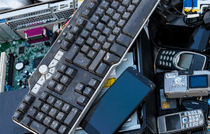
In a Zero Waste world, cell phones still exist, but the story behind them is significantly different. We can chat wire-free but responsibly, taking the true costs to the environment and to other cultures into account. Rather than having mountains of cell phones and other electronic scrap pour into our waste stream while manufacturers blithely head back for more coltan and other raw materials to make new ones, states need to take action by adopting producer responsibility measures that require electronics manufacturers— not you—to pay for the proper recycling of their products. Once manufacturers handle their own waste, they’ll reevaluate a phone’s design so it’s less toxic, easier to dismantle and able to be upgraded at least once or twice before it’s replaced. Manufacturers will also have to pay a fair market price for ethically-sourced Congolese coltan, which ties the economic stability of the region to the success of the peace process.
Back home, these measures will create local green jobs and business opportunities in reclaiming precious materials and in refurbishing cell phones and other electronics for reuse. You can take action now by resisting the urge to purge your old cell phone and sticking with it longer. When you do buy, buy refurbished, and support your local refurbished phone company, Cellular Recycler (read our Zero Waste Business Profile on Cellular Recycler).
© Copyright 2010 Eco-Cycle, Inc. All Rights Reserved
No part of this publication may be transmitted or reproduced in any form without the express permission of the publisher. |