











Producer Responsibility Plan for Colorado Approved
After years of planning, the State of Colorado approved the plan for implementing Producer Responsibility in the state, which will provide free recycling to all residents when fully implemented.
On Wednesday, December 10, 2025, the Colorado Department of Public Health and Environment (CDPHE) approved the Circular Action Alliance (CAA) plan to implement Producer Responsibility for paper and packaging in the state. This represents a major milestone in advancing this landmark legislation, which Eco-Cycle helped draft and champion in 2022 (HB22-1355 Producer Responsibility for Packaging Act).
With this approval, Colorado became the second in the nation—following Oregon—to adopt a plan and move forward with implementation. The program will provide convenient recycling access to all Colorado residents that is entirely paid for by the producers of the packaging—not by residents or local governments.
Colorado predicted to recycle as much as 60% of consumer packaging by 2035
The plan lays out the roadmap of how CAA Colorado, which is the Producer Responsibility organization for Colorado, will meet the State-approved recycling goal for recycling up to 60% of Colorado’s consumer packaging by 2035. CAA Colorado worked with CDPHE and the State-appointed Producer Responsibility Advisory Board over the past year to develop and refine the plan. Now that the plan is approved, CAA Colorado will start working to get no-cost recycling to Colorado households statewide.
The cost of recycling will shift from consumers and communities onto companies that sell packaged products in Colorado
Currently, the cost of recycling is paid for by you, the consumer, and by your municipality or county. As Colorado’s Producer Responsibility program is implemented, the cost of recycling will be paid for by the companies that sell packaged consumer products in Colorado, including items such as juice boxes, cans, bottles, the wrapping around clothes, and the boxes and mailers delivered to your door.
How the new Producer Responsibility program will work
CAA Colorado will start working with local governments and recycling service providers to finalize details about how and when recycling services will be reimbursed. Some communities will begin being reimbursed for recycling services starting in June of 2026.
- In communities where recycling services are lacking, or where the local government chooses not to participate in the program, residents will still receive no-cost recycling, but it will take longer to roll out.
- If you currently live in a community that has either municipally run waste collection services (like Denver and Longmont), or municipally contracted services (like Lafayette and Arvada) your city will be reimbursed by CAA for the recycling services already being provided. If you live in a single-family home in these communities, you should either see a reduction in your recycling bill, or possibly an increase in other Zero Waste services—e.g., your community might choose to use the amount residents previously paid for recycling to add services like organics collection or hazardous waste collections.
- If you live in a community that has an open market for waste collection, where homeowners choose their own hauler, each hauler will need to sign an agreement with CAA to get reimbursed for recycling services. It will probably take longer for CAA to start reimbursing individual haulers than it will in communities that have organized services.
The environmental and economic benefits of the Producer Responsibility Program
- The program will increase access to recycling for an additional 500,000 households, providing no-cost recycling to ALL Coloradans by 2030.
- The Producer Responsibility plan creates one set of recycling guidelines for the entire state. That means locals and visitors alike will be able to recycle the same packaging in every Colorado town or city.
- By 2035, an additional 410,000 tons of valuable materials will be recovered, such as cardboard, aluminum, glass, and recyclable plastics, for a total of 720,000 tons recycled annually—a 132% increase from today.
- This additional recycled material will be made available as post-consumer content for companies to include when making new packaging, reducing the need for natural resource extraction.
- The new, expanded system will create an additional 7,900 recycling-related jobs.
- The new system will reduce annual greenhouse gas emissions equivalent to removing 278,000 cars off the road by 2035.
- The new system will save municipalities and residents millions of dollars each year. The state estimates the cost savings for Denver alone will be up to $16.3 million in 2035.
- The new system rewards companies that sell packaged products in Colorado to use less packaging and design packaging to be more recyclable and use more recycled content. This is because companies are charged according to the amount of packaging and types of packaging they use: the more sustainable their packaging is (i.e., reusable or recyclable) the less they have to pay into the system. For example, producers will pay less per pound for highly recyclable aluminum than they will for non-recyclable plastics.
What you can do to ensure that you benefit from the Producer Responsibility Program
If your community already has a coordinated recycling system—where your city or county arranges recycling collection through a unified program or hauler contracts—contact your city or county to ask them to seek reimbursement from CAA and learn how that reimbursement may affect your rates or service.
If you live in an open-market system, where individual households choose their own recycling and trash hauler, contact your hauler directly and ask whether they plan to seek reimbursement from CAA and what that could mean for your bill or service.
Cities and counties may choose to adopt coordinated recycling systems at any time. Coordinated recycling not only reduces truck traffic, air pollution, road damage, and safety risks, but also makes it easier—and likely faster—for CAA to reimburse recycling costs by streamlining how services and data are managed.
Free recycling applies to those living in apartment or multifamily buildings, or in a Home Owners Association (HOA)
The law requires the program to provide recycling services to all residents, including those in HOAs, and multifamily housing such as apartments. Haulers servicing multifamily buildings and HOAs will need to sign an agreement with CAA to be reimbursed. Contact your property owner or manager and inquire about the hauler getting reimbursed to ensure you benefit from the free service.
Communities currently without recycling can expect to see services by 2030
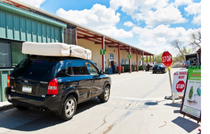
The law requires that recycling be as convenient as trash services. For residents that haul their own trash to the landfill, they will have free access to recycling drop-off sites (likely at the landfill). If you have curbside trash service, you will also gain access to curbside recycling service. Because recycling haulers will need to increase their capacity by hiring new drivers and buying new trucks in order to add new service routes, it will likely take longer for you to start receiving free recycling service. The goal is to add these services by 2030. Be sure to inquire with your local elected officials, city staff, or haulers to see if they are aware of the program and if they have connected with CAA.
The Plan prevents greenwashing from plastics manufacturers by requiring verifiable and transparent tracking
The approved plan requires that materials considered “recycled” through the program must be verifiably tracked and accounted for. Some in the plastics industry argued for accounting methods that could not guarantee that materials were recycled into new plastic products rather than being turned into fuel. These so-called “free allocation” accounting schemes also would have allowed companies to market their packaging with higher amounts of recycled content than they might actually include. Eco-Cycle, along with other environmental organizations, and over 900 residents who submitted comments to the State, helped push CDPHE to keep free allocation out of the plan for this year.
Some in the plastics industry are continuing to fight to get free allocation in the plan and are now suing the State to include it. We must ensure that we have an authentic and transparent recycling system in Colorado by requiring verifiable, transparent methods for tracking recycled content.
What’s next?
While the program will begin June 2026, it will take several years to get recycling to every resident in the state.
Over the coming months and years, CAA will continue to work with local governments and recycling service providers, like Eco-Cycle, to negotiate specific details of how the plan will fund education and outreach programs, expand curbside recycling programs, and process the resulting increase in valuable materials expected to be collected throughout the state.
Alongside our partners, Eco-Cycle will keep collaborating with CAA and CDPHE to help implement a plan that best serves Colorado’s communities. We’re excited to bring decades of real-world experience—from Boulder County to communities across the state—to support the rollout of strong, successful recycling programs statewide.